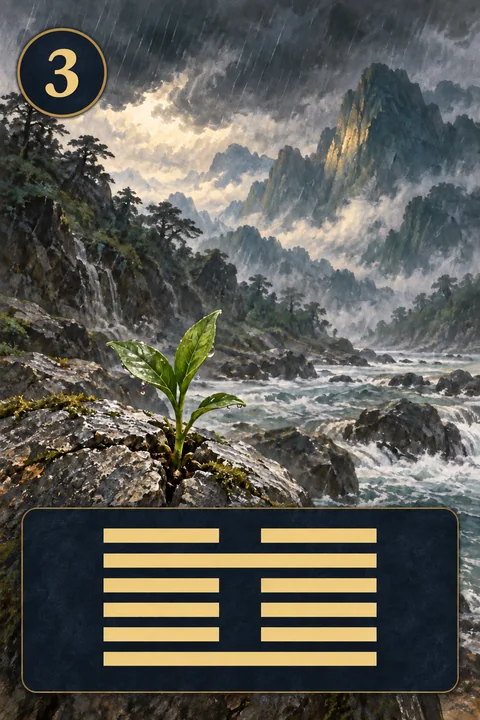
Explore this tradition with a welcoming guide, an example and the keys to your consultation.
The reading and its nuances
This card reading brings together three hexagrams as images of a situation in motion. Their order distinguishes background, the current moment and a future perspective. Interpretation develops between those positions and your question.
How this consultation works
This card variant uses the 64 hexagrams. Choose three different cards: past, present and future, in that order. The cards have no changing lines; changing lines belong to the coin consultation.
An example reading
With hexagrams 1, 2 and 53, an example reading might move from initiating something to making room for it and then developing gradually. Compare that thread with your question. These are three selected cards, not one hexagram changing into the other two.
FAQ
Do these cards have changing lines?
Not in this variant. You select three different cards and read them by position. Building six lines and changing them belongs to the coin version of the I Ching.
How can I focus the consultation?
Choose one subject and a clear question. If the tool has no question field, keep it as a personal reference. Connect the symbol with a specific situation and note both what fits and what remains open.
Is retrying the same as starting a new consultation?
When Retry this reading appears, you can continue with the same question and selection. A new consultation allows another draw, and AI may write a different interpretation. The pauses and usage limits remain in place.
How can I connect the reading with real life?
Separate the symbol from what you know through experience. Use its contrast to ask a question or explore a possibility; examples illustrate a reading without certifying facts or fixing the future.
Can I keep the result and add notes?
Use Save reading once the result is complete. In My readings you can reopen it, add notes and download it as text. Data stays in this browser; use the library backup if you want to keep it when changing devices.