Entdecke dein Schicksal gemäß den Göttern des Nils
Persönlichkeit
Der Mann
Die Frau
Affinität
Die ägyptischen Orakel werden befragt…
Explore the deity associated with your date in this version and use its image to open a personal reading, with an example and a question.
What this tool calculates
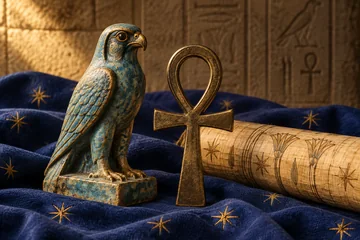
This version associates twelve Egyptian deities with fixed month-and-day ranges. It retains this site's variant and shows the dates for each result. It does not reconstruct the ancient Egyptian calendar or the historical Dendera zodiac; other sites may use different associations.
An example to understand the date
January 19 corresponds to Thoth and January 20 to Isis. February 29 falls within Osiris’s interval. The association depends on day and month, so different years retain the same deity for the same date. The result displays the inclusive interval used.
How to work with your reading
Approach the deity as a narrative image: observe its central theme, read the example and choose which question deserves more time. These contemporary reflection prompts take symbolic inspiration from the figures; they are not translations of an ancient Egyptian birth horoscope. Related themes broaden the reading without classifying people.
FAQ
How to use it
Enter your full birth date, calculate and read the result. Return to the form to use another date. Supported dates: 1900–2100, up to today.
Are these dates a reconstruction of the Dendera zodiac?
No. This tool uses a modern correspondence between twelve deities and fixed date ranges. The Dendera zodiac is a different historical object. Other websites may use different modern mappings, so compare the intervals first.
Do I need my birth year, time or place?
The form asks for a complete date to check that it is valid. The deity is assigned by day and month; time and place are not involved. The year validates cases such as February 29 but does not change the association for the same day and month.
Does AI create a new response each time?
No. These five tools calculate a calendar correspondence and display texts from a prepared catalogue. The same date and language preserve the reading. The examples are contemporary editorial reflection prompts, not verified predictions.
How do I save the reading and my own notes?
Once the result appears, use “Save reading”. Reopen it in “My readings” through the magnifying glass or star panel, add notes and download it as text. It stays in this browser without registration; clearing browser data can also remove the readings.
Sources and convention
This version associates twelve Egyptian deities with fixed month-and-day ranges. It retains this site's variant and shows the dates for each result. It does not reconstruct the ancient Egyptian calendar or the historical Dendera zodiac; other sites may use different associations.